Measure the bicycle as it will be stored
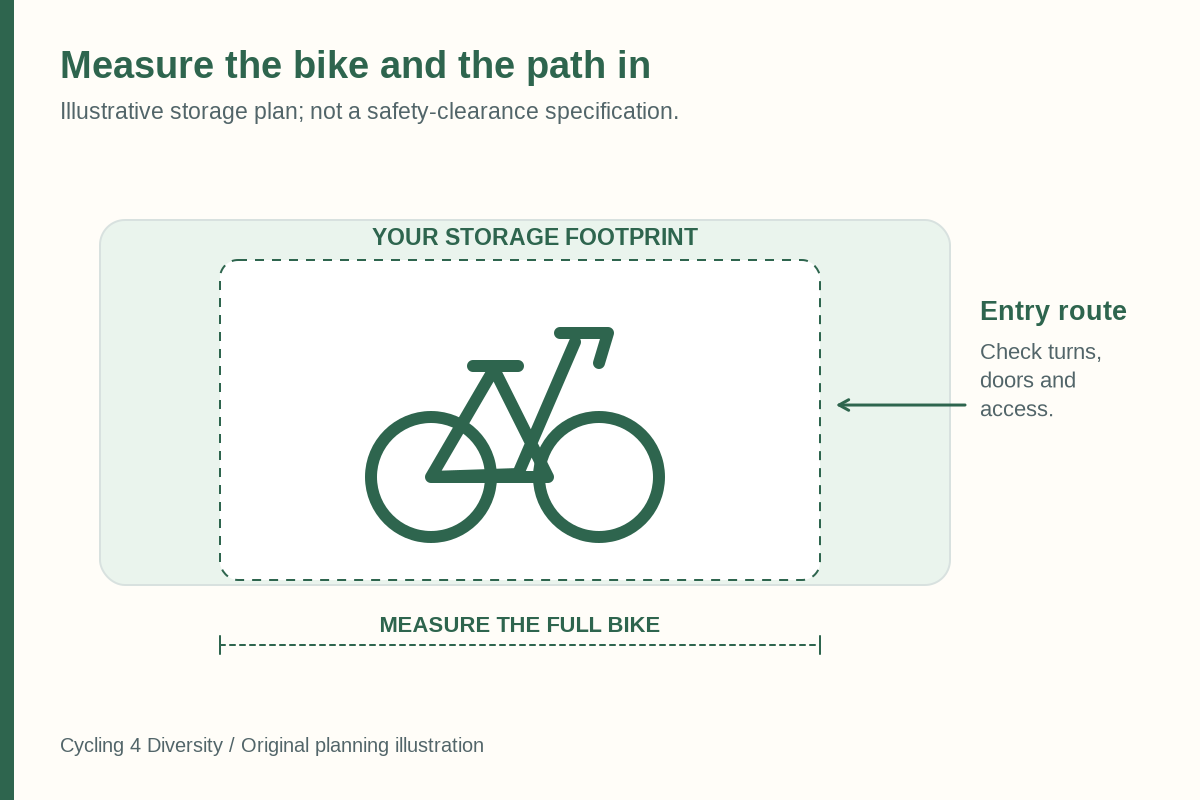
Record the full length, handlebar width and height, plus any baskets, racks or accessories that stay attached. Pedals and handlebars can project beyond the wheels, so a tire footprint alone is not a complete storage plan. Measure the actual bike rather than borrowing dimensions from a different frame size.
Describe the arrival routine: the door used, the direction you enter and the place where you turn or lift the bike. A storage spot can contain a stationary bicycle yet be difficult to use every day if the route to it requires awkward maneuvers.
Compare systems by what they require
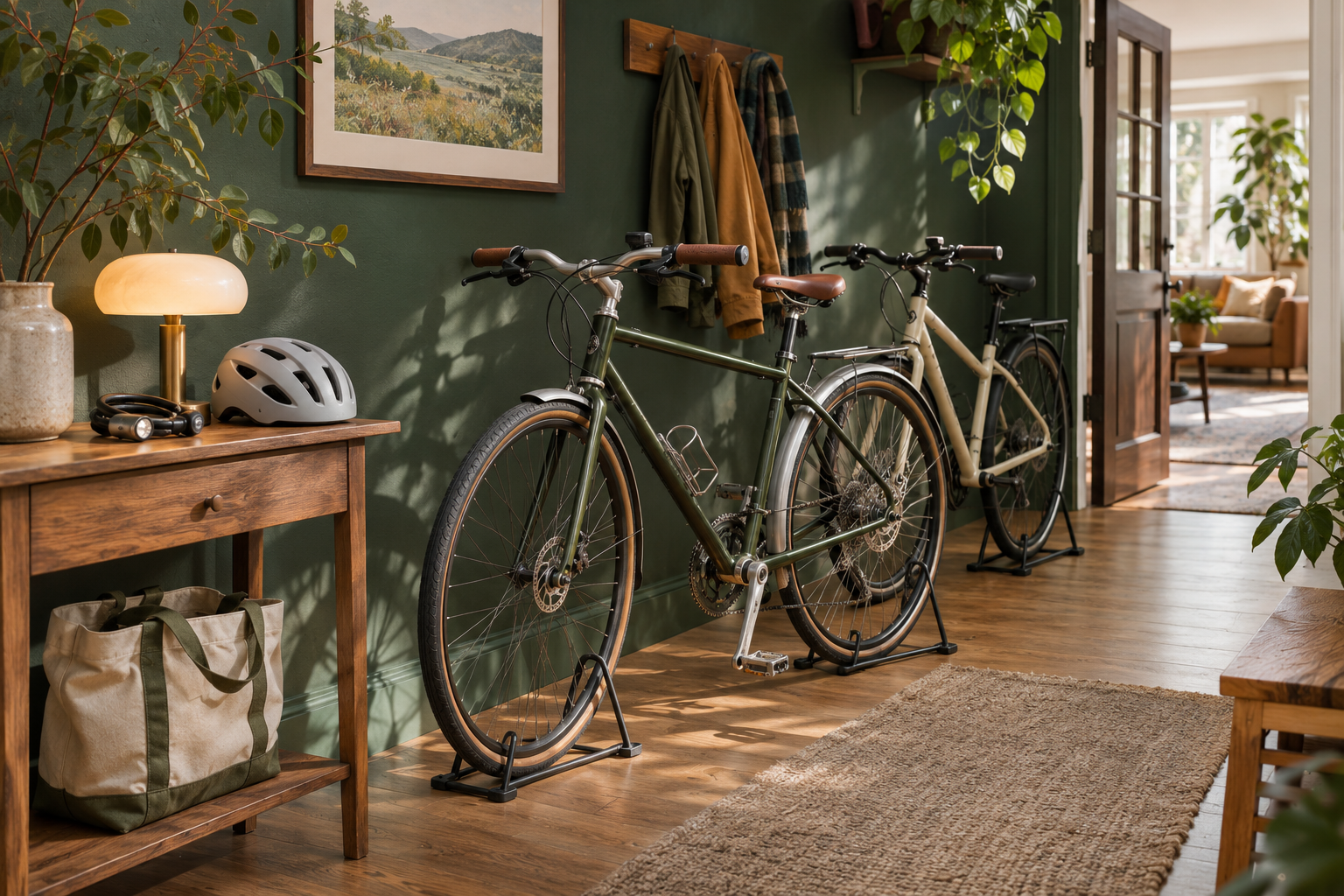
REI’s storage guide distinguishes floor, wall and overhead approaches. For any candidate, check its compatibility with the bicycle, support requirements and installation instructions. Your lease or building rules may also affect what you can install.
As one manufacturer example, Feedback Sports describes RAKK 2.0 as a freestanding stand that supports a bicycle by a front or rear tire. That does not establish compatibility with every tire or accessory. Check the exact version and current specifications; related RAKK models are not interchangeable specification sheets.
Mark the stationary and moving envelopes
Mark the bike’s measured outline on the floor with removable paper or another method appropriate for the surface. Then trace how the bike would enter and leave. Include the chosen stand’s outer footprint and the access required by its instructions.
Avoid treating a floor-plan calculation as an installation or structural assessment. Do not assume that a wall, ceiling, shelf or rack can support a load because it fits geometrically. Use the product instructions and an appropriate installer when a proposed system requires one.
Choose a setup you can repeat
- Bike and accessories fit the exact storage system’s compatibility information.
- The full bike fits the intended location, not only its wheels.
- Doors and ordinary access remain usable.
- Building conditions and installation requirements are checked.
- A place is assigned for removable accessories and wet or dirty items.
- The arrival and departure routine can be completed without moving unrelated furniture each time.
Apartment-bike storage comparison
| Check | Floor option | Wall / other option |
|---|---|---|
| Bike compatibility | Exact bike and system | Exact bike and system |
| Stored footprint | Measure full envelope | Measure full envelope |
| Arrival / departure | Trace the route | Trace the route |
| Installation / permission | Check requirements | Check requirements |
| Remaining obstacle | Record the actual issue | Record the actual issue |
Put the plan to work
Use your own information to make a practical next step.
Space-fit calculatorSources and review
These sources support the factual details in this guide. Policies, prices and services can change; check the official source before acting.
- REI: bicycle storage optionsChecked November 24, 2026
- Feedback Sports: RAKK 2.0 freestanding bicycle standChecked November 24, 2026
An original planning resource. Sources identify the factual references used; examples and worksheets are our own.
How these guides are prepared